
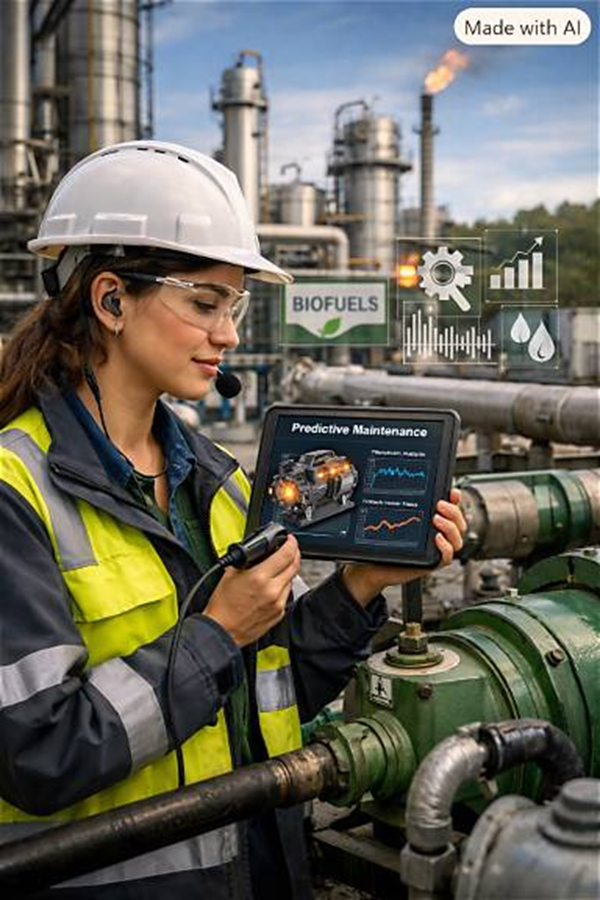
Artificial Intelligence (AI) has permeated nearly every aspect of our lives; from how we communicate to how industries operate. One of its most transformative applications in the chemical sector is predictive maintenance, that is redefining equipment reliability and operational efficiency.
Chemical industries rely on complex machinery and equipment, where safety and productivity hinge on continuous maintenance. Traditionally, machines are either repaired after breakdown leading to unplanned downtime, high repair costs and production losses. Another approach is machines are serviced at periodic intervals leading to over maintenance, wasted resources and unnecessary downtime. Both these approaches are costly and inefficient. This is where AI steps in and is a game changer.
Equipments have sensors which monitors operating and safety parameters like temperature, pressure, flow, levels, etc. Even at a lab scale, the number of such sensors is numerous and consider the number of these at a manufacturing plant. AI systems can quickly analyze data from thousands of such sensors attached to monitoring equipment (vibration, temperature and pressure). Machine learning algorithms, identifies pattern that can indicate potential equipment failures. These can act as signals for the maintenance teams to proactively address the issues and reducing downtime (which is cost to a company), similarly unnecessary maintenance can be avoided, which is again a cost factor.
Industry Leaders Driving Adoption
BASF
The Germany chemical giant BASF (Badische Anilin- & Soda-Fabrik, Germany), is one of the largest chemical companies in the world, and having manufacturing facilities across the world. BASF worked with ABB[1] to create solutions that go from wireless sensors up to advanced analytics and an enterprise dashboard for the assets. BASF has claimed a 15% reduction in unplanned downtime and every reduction in unplanned downtime is significant cost savings.
Shell
In 2022, oil major Shell scaled predictive maintenance globally in partnership with C3 AI, an enterprise AI software company.[2] Over 10,000 pieces of equipment (control valves, pumps, compressors, and other critical components) across upstream, manufacturing, and integrated gas assets were monitored, with data processing of providing 20 billion rows of data weekly from more than 3 million sensors. Nearly 11,000 machine learning models in production, generating 15 million predictions daily.
ExxonMobil
Another oil major, ExxonMobil uses predictive maintenance services to monitor lubricant performance and equipment health.[3] By combining its lubrication management platform, Machinext, with Mobil Lubricant Analysis, the company continuously monitors the condition of lubricants, greases, and coolants. The data collected helps identify potential equipment issues before machinery failure occurs, enabling manufacturers to reduce downtime, optimize maintenance schedules, and avoid unnecessary maintenance costs.
AI predictive maintenance is more than a cost-saving tool — it is a strategic enabler of industrial transformation. Improves efficiency by maximizing uptime and asset utilization. Sustainable by reducing waste and energy inefficiencies and improves safety by preventing hazardous failures, protecting workers and environment. As chemical and energy companies embrace AI, predictive maintenance is emerging as a cornerstone of the industry’s digital future.
[1] Basf chemical plant – Case studies | Refining and Chemicals | ABB (2018). https://new.abb.com/oil-and-gas/case-studies/refining-and-chemicals/basf-chemical-plant
[2] https://ir.c3.ai/news-releases/news-release-details/shell-achieves-major-milestone-scales-artificial-intelligence#:~:text=Supports%20global%20deployment%20across%20Shell’s,and%20Microsoft%20are%20founding%20members
[3] ExxonMobil expands predictive maintenance service in Indonesia | Asian Business Review
Leave a Reply